
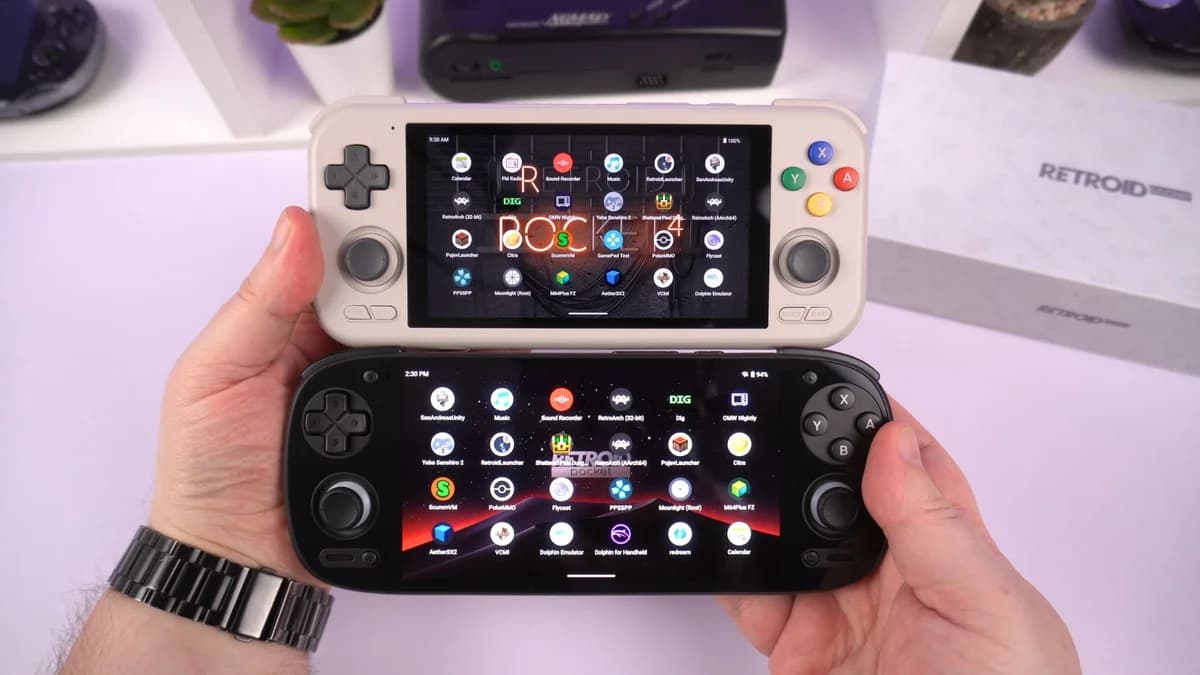
The Retroid Pocket 6 launched in late 2025 as the direct successor to the highly successful Pocket 5, bringing Qualcomm's flagship Snapdragon 8 Gen 2 chipset and a 120Hz AMOLED display to the sub-$250 Android handheld market. With the Pocket 5 remaining available at a discounted $199 (down from $219) and the Pocket 6 priced at $244, buyers face a genuine dilemma: save $45 with the proven Pocket 5, or invest slightly more for the generational leap in performance source.
This comparison breaks down every specification, performance metric, and real-world usage scenario to determine whether the Pocket 6 justifies its modest premium—or if the Pocket 5 remains the smarter purchase in 2026.
Price Comparison: The $45 Question
As of April 2026, both devices remain actively available from GoRetroid's official store, creating meaningful choice for buyers:
| Model | Price | Status | Value Proposition |
|---|---|---|---|
| Retroid Pocket 5 | $199 (sale) / ~~$219~~ | Available (Refurbished $156 sold out) | Best price-to-performance for 8th-gen emulation |
| Retroid Pocket 6 | $244 | Second batch pre-order (ships March 2026) | Flagship performance in pocketable form factor |
Price Analysis: The $45 gap between Pocket 5 and Pocket 6 ($25 if comparing to RP5's regular price) represents approximately 18-23% more investment. However, this buys you a two-generation silicon leap (Snapdragon 865 to 8 Gen 2), faster RAM (LPDDR4x to LPDDR5x), 120Hz display upgrade, 20% larger battery, and WiFi 7 connectivity source.
For context, the Snapdragon 8 Gen 2 powered devices like the AYN Odin 2 typically command $300+ pricing. Retroid's aggressive $244 positioning makes the Pocket 6 one of the most affordable entry points into flagship-tier Android handheld performance.
Complete Specs Comparison
| Specification | Retroid Pocket 5 | Retroid Pocket 6 | Difference |
|---|---|---|---|
| Processor | Snapdragon 865 | Snapdragon 8 Gen 2 | +2 generations, ~40% faster |
| CPU | 1×A77@2.8G + 3×A77@2.4G + 4×A55@1.8G | 1×GoldPlus@3.2GHz + 4×Gold@2.8GHz + 3×Silver@2.0GHz | Significantly faster cores |
| GPU | Adreno 650 | Adreno 740@680MHz | ~2× graphics performance |
| RAM | 8GB LPDDR4x @ 2133MHz | 8GB or 12GB LPDDR5x | Faster memory standard |
| Storage | 128GB UFS 3.1 | 128GB/256GB UFS 3.1 | 256GB option on RP6 |
| Display | 5.5" AMOLED 1080p @ 60Hz | 5.5" AMOLED 1080p @ 120Hz | 2× refresh rate |
| Brightness | ~400 nits | 550 nits maximum | +37% brighter |
| Battery | 5000mAh | 6000mAh | +20% capacity |
| Fast Charging | Standard | 27W fast charging | Faster recharge |
| Connectivity | WiFi 6 + BT 5.1 | WiFi 7 + BT 5.3 | Future-proofed wireless |
| Cooling | Active cooling | Active cooling with copper spreader | Improved thermal design |
| Weight | 280g | 304-320g | +24-40g (larger battery/cooling) |
| Dimensions | 199.2 × 78.5 × 15.6mm | 205.5 × 80.5 × 17.2mm | Slightly larger |
| OS | Android 13 | Android 13 | Same |
| Controls | 3D Hall sticks, Analog L2/R2 | 3D Hall sticks, Analog L2/R2 | Same (layout configurable on RP6) |
*Sources: GoRetroid Pocket 5, GoRetroid Pocket 6, RetroDodo RP6 Review*
Display Quality: 60Hz vs 120Hz AMOLED
Both devices feature 5.5-inch 1080p AMOLED panels with 16:9 aspect ratios, but the Pocket 6's 120Hz refresh rate fundamentally changes the user experience. The Pocket 5's 60Hz panel—while bright, vibrant, and crisp with seamless glass integration—cannot match the smoothness of the Pocket 6's 120Hz display source.
Pocket 5 Display Assessment:
"From the moment that you turn it on, the screen just pops, and everything looks bright, vibrant, and crisp. I really can't get over how nice of a screen the Pocket 5 has, especially considering that it costs less than $250." — Retro Handhelds
Pocket 6 Display Assessment:
"There's no screen tearing, no light bleed, great brightness adjustments, and it's incredibly crispy." — RetroDodo
Key Differences:
- Refresh Rate: The Pocket 6's 120Hz enables smoother scrolling, reduced motion blur in fast-paced games, and better responsiveness in Android gaming. The Pocket 5's 60Hz is adequate for retro emulation but shows its limitations in modern Android titles.
- Brightness: The Pocket 6 reaches 550 nits maximum brightness versus the Pocket 5's ~400 nits, improving outdoor visibility—a noted weakness of the Pocket 5 compared to competitors like the Odin 2 Mini source.
- 16:9 Limitation: Both screens share the same widescreen format, which creates black bars on 4:3 retro content. Only PSP games natively fill the display without stretching or cropping.
Performance and Emulation Capabilities
The performance delta between Snapdragon 865 and 8 Gen 2 represents the most significant differentiator between these devices. While both handle retro emulation excellently, the Pocket 6 pushes into higher-tier territory for demanding systems.
Retroid Pocket 5 Performance:
- Excellent: PS1, N64, Dreamcast, Saturn, PSP at high upscaling
- Good: GameCube, Wii, PS2 at 1.5x-2x native resolution, 3DS (most titles)
- Limited: Nintendo Switch (some playable titles, extensive tinkering required)
- Android Gaming: Full compatibility with demanding titles like Honkai: Star Rail, Zenless Zone Zero source
Retroid Pocket 6 Performance:
- Excellent: All 8th-gen systems (PS2, GameCube, Wii) at 2x-3x upscaling
- Good: Wii U, 3DS at higher resolutions with enhanced visuals
- Capable: Nintendo Switch emulation significantly improved (though still requires driver optimization)
- PC Gaming: Better compatibility with GameHub and local PC game streaming
GPU Overclocking: The Pocket 5 can achieve steady 60 FPS in demanding titles with GPU overclocked to 1100MHz at reduced resolution (540p/810p), but this requires thermal management and fan noise trade-offs. The Pocket 6's Adreno 740 delivers this performance natively without overclocking source.
Battery Life: 5000mAh vs 6000mAh
The Pocket 6's 6000mAh battery (20% larger than the Pocket 5's 5000mAh) combined with the more efficient 4nm Snapdragon 8 Gen 2 process yields meaningful real-world improvements, though the gap narrows in demanding use cases where the more powerful chip consumes additional power.
Retroid Pocket 5 Battery Test Results:
| Usage Scenario | Duration |
|---|---|
| Android Games (Honkai Star Rail) | 3h 35m |
| Switch Emulation | 3h 35m |
| GameCube/PS2 (3x upscaling) | 3h 35m |
| Game Boy Advance | 11 hours |
| Standby Drain | 5-8% per 24 hours |
*Source: Joey's Retro Handhelds testing at max brightness/performance source*
Retroid Pocket 6 Battery Expectations:
| Usage Scenario | Estimated Duration |
|---|---|
| Mixed Use (PS2 + Android + Retro) | 4.5-6 hours |
| Light Use (GBA, Genesis, small Android) | 6-8 hours |
| Heavy/Performance Mode | 2.5-4 hours |
The Pocket 6 also gains 27W fast charging support versus the Pocket 5's standard charging, reducing downtime between sessions source.
Build Quality and Design Differences
Both devices maintain Retroid's design DNA with premium plastic construction, Hall-effect analog sticks (eliminating drift), and analog L2/R2 triggers. However, subtle improvements distinguish the Pocket 6:
Retroid Pocket 5 Design:
- Weight: 280g (comfortable for extended sessions)
- Dimensions: 199.2 × 78.5 × 15.6mm
- Colors: GC (GameCube purple), 16Bit, Black, White
- Criticism: D-pad positioning above the analog stick creates thumb cramping for some users; "stick-heavy games" can cause hand strain source
Retroid Pocket 6 Design:
- Weight: 304-320g (heavier due to larger battery and cooling)
- Dimensions: 205.5 × 80.5 × 17.2mm (slightly larger)
- Colors: Silver, 16Bit, Black, Orange, Light Purple
- Improvement: Configurable layout (D-pad top or stick top) based on community feedback from Pocket 5 criticism
- Cooling: Active cooling with copper heat spreader for sustained performance
Build Assessment: The Pocket 6 has been criticized for a "generic" design that lacks differentiation from competitors—"you could slap any other handheld manufacturer's logo on this, and you'd believe it was made by them" source. The Pocket 5, while also employing standard Android handheld aesthetics, distinguished itself through the GameCube colorway and more compact dimensions.
Storage and RAM Considerations
Storage Limitations (Both Devices): The 128GB internal storage on both base models presents the primary practical limitation. GameCube/Wii, PS2, and Switch emulators require internal storage, as do modern Android games (20-28GB each). Users should plan for microSD expansion or opt for the Pocket 6's 256GB configuration source.
RAM Analysis:
- Pocket 5: 8GB LPDDR4x (sufficient for most use cases, though HD texture packs can strain resources)
- Pocket 6: 8GB or 12GB LPDDR5x (12GB variant discontinued as of March 2026 due to RAM prices; 8GB now $249)
The LPDDR5x memory in the Pocket 6 provides higher bandwidth and lower power consumption than the Pocket 5's LPDDR4x, contributing to both performance and efficiency gains.
Verdict: Which Should You Buy?
Buy the Retroid Pocket 6 if:
- You want maximum performance for PS2, GameCube, and Wii upscaling
- You play modern Android games that benefit from 120Hz and faster GPU
- Battery life matters for your typical usage (lighter workloads)
- You value configurable button layout options
- You plan to experiment with Wii U, 3DS, or Switch emulation
- You want WiFi 7 and Bluetooth 5.3 for future-proofing
Buy the Retroid Pocket 5 if:
- You primarily emulate through PS2/GameCube at native or modest upscaling
- Your budget is strictly capped under $220
- You prefer the lighter 280g weight for extended portable sessions
- You love the GameCube colorway aesthetic
- You already own a more powerful handheld for demanding systems
Clear Winner: Context-Dependent
The Retroid Pocket 6 wins on raw specifications and future-proofing—the Snapdragon 8 Gen 2 represents a meaningful generational leap that justifies the $45 premium for performance-focused users. The 120Hz display, 6000mAh battery, and improved wireless connectivity address every hardware limitation of the Pocket 5 while maintaining the same excellent AMOLED screen quality.
However, the Retroid Pocket 5 at $199 remains an exceptional value for retro-focused gamers whose targets stop at PS2/GameCube. The Snapdragon 865 handles 8th-generation emulation competently, the OLED display is gorgeous, and the lighter weight improves portability. If you're upgrading from an RP4 Pro or earlier device, either represents a massive improvement.
RetroDodo's Upgrade Advice:
"No. The Pocket 5 and G2 are way too similar in both design, comfort, and specifications for me to feel comfortable advising you to pay a large $250 price tag for such a small return." source
Bottom Line: First-time Android handheld buyers should strongly consider the Pocket 6 for its longevity. Existing Pocket 5 owners should skip this generation unless specifically dissatisfied with their current performance. Budget-conscious buyers prioritizing value over bleeding-edge specs will find the discounted Pocket 5 an excellent companion device.
Frequently Asked Questions
Q: What is the difference between Retroid Pocket 5 and 6?
The Retroid Pocket 6 upgrades the processor from Snapdragon 865 to Snapdragon 8 Gen 2 (~40% faster), increases RAM speed from LPDDR4x to LPDDR5x, boosts the display refresh rate from 60Hz to 120Hz, enlarges the battery from 5000mAh to 6000mAh with 27W fast charging, and upgrades connectivity from WiFi 6 to WiFi 7. The Pocket 6 also offers configurable button layouts (D-pad top or stick top) and a 256GB storage option, though it is slightly heavier (304g vs 280g) and larger than the Pocket 5 source.
Q: Is the Retroid Pocket 5 uncomfortable?
The Retroid Pocket 5 improved significantly over the RP4 Pro's comfort issues, with better grips enabling sessions longer than 30 minutes. However, some users report thumb cramping due to the D-pad placement above the analog stick, particularly in games heavy on stick usage. The 280g weight is comfortable for most users, though individual hand size and grip style affect ergonomics source.
Q: Is the Retroid Pocket 6 OLED?
Yes, the Retroid Pocket 6 features a 5.5-inch AMOLED display—the same panel technology as the Pocket 5. However, the Pocket 6 upgrades the refresh rate to 120Hz (from 60Hz) and increases maximum brightness to 550 nits (from ~400 nits). Both displays deliver vibrant colors, deep blacks, and crisp 1080p resolution, but the Pocket 6's higher refresh rate provides smoother motion in games and UI navigation source.
Q: Does Retroid Pocket 5 have WiFi 6?
Yes, the Retroid Pocket 5 includes WiFi 6 (802.11ax) and Bluetooth 5.1 connectivity, providing modern wireless performance for online gaming, cloud streaming, and peripheral connectivity. The Pocket 6 upgrades this to WiFi 7 and Bluetooth 5.3 for improved bandwidth, lower latency, and better future compatibility source.
Q: Should I upgrade from Pocket 5 to Pocket 6?
Generally, no. The performance gains, while measurable, do not justify the $244 upgrade cost for existing Pocket 5 owners unless you specifically need higher upscaling for PS2/GameCube, better Switch emulation, or the 120Hz display. The Pocket 5 remains capable for its target emulation range, and reviewers explicitly advise against upgrading from the Pocket 5 or G2 to the Pocket 6 given the similarities in design and the modest performance returns for the price source.
Internal Links
- Retroid Pocket 5 Device Page
- Retroid Pocket 6 Device Page
- Best Android Handhelds 2026
- Retroid Pocket 5 Setup Guide
Sources
- GoRetroid. "Retroid Pocket 5 Product Page." https://www.goretroid.com/products/retroid-pocket-5
- GoRetroid. "Retroid Pocket 6 Product Page." https://www.goretroid.com/products/retroid-pocket-6-handheld
- RetroDodo. "Retroid Pocket 6 Review." https://retrododo.com/retroid-pocket-6-review/
- Retro Handhelds. "Retroid Pocket 5 Review." https://retrohandhelds.gg/retroid-pocket-5-review/
- Joey's Retro Handhelds. "Retroid Pocket 5 Review." https://www.joeysretrohandhelds.com/reviews/retroid-pocket-5-review/
- DroiX. "Retroid Pocket G2 and Pocket 6 Announced." https://droix.net/blogs/retroid-pocket-g2-and-pocket-6-announced/
- Retro Catalog. "Retroid Pocket 6 vs Retroid Pocket 5 Comparison." https://retrocatalog.com/compare/retroid-pocket-5/retroid-pocket-6
- kiboTEK. "Retroid Pocket 6 Full Specifications." https://www.kibotek.com/en/kibonews/retroid-pocket-6-full-specifications-at-kibotek/
