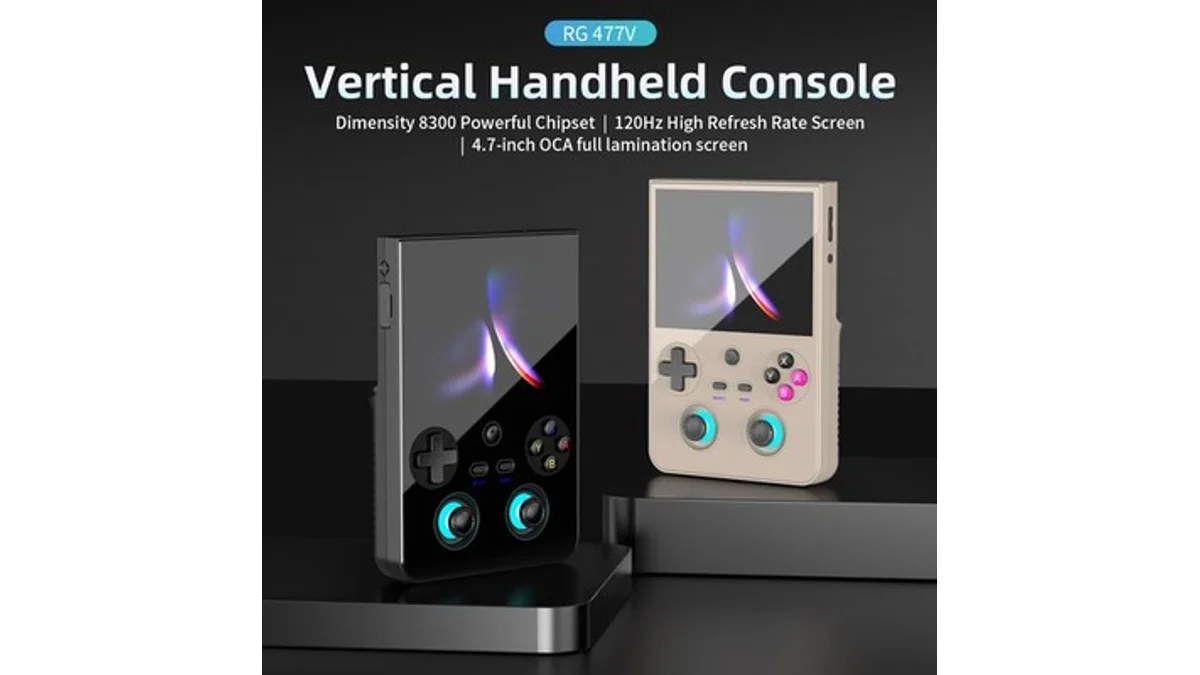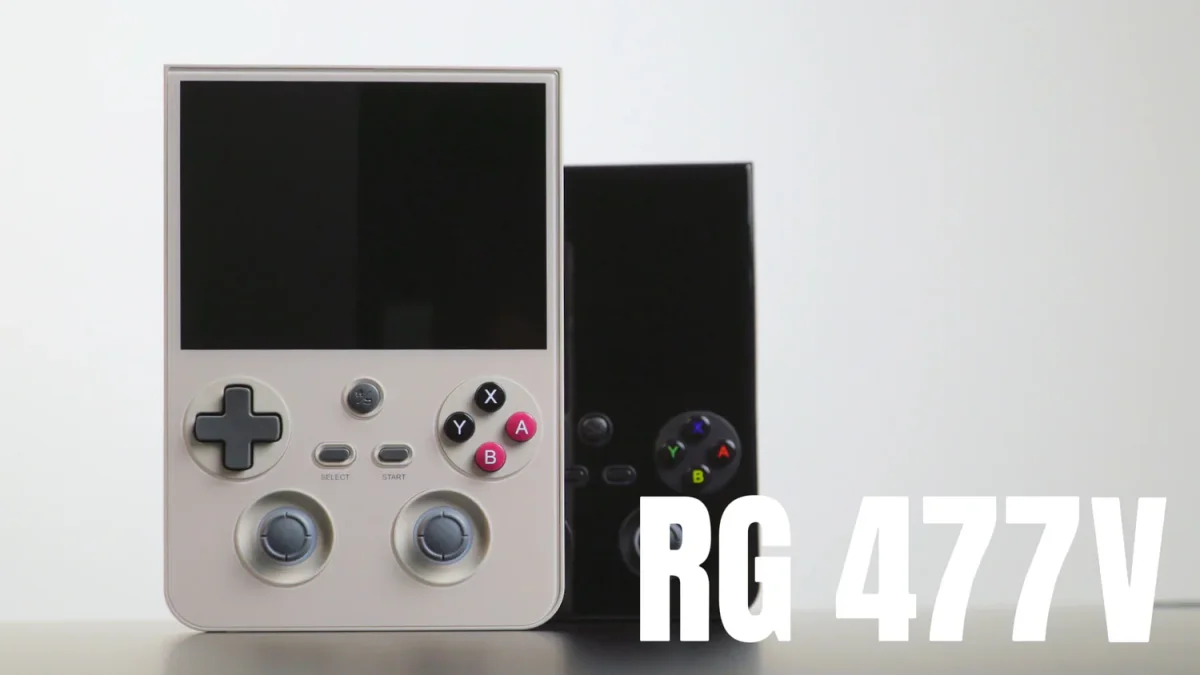
The Anbernic RG477V is what happens when a manufacturer finally listens. For years, enthusiasts have asked for a vertical handheld that doesn't compromise on performance—something that can handle Dreamcast, N64, and even PS2/GameCube while maintaining that classic Game Boy form factor. Anbernic answered with the RG477V, and after weeks of testing, it's clear they've created their best vertical handheld yet—though not without some quirks.
Released in December 2025, the RG477V represents a significant departure from Anbernic's typical budget-focused approach. At $219-239, it competes directly with the Retroid Pocket 5 and sits below the AYN Odin 2 Portal. The headline feature is the MediaTek Dimensity 8300 chipset—a processor that delivers flagship-tier CPU performance with a GPU that occasionally complicates things.
Design: Big, Bold, and Vertical
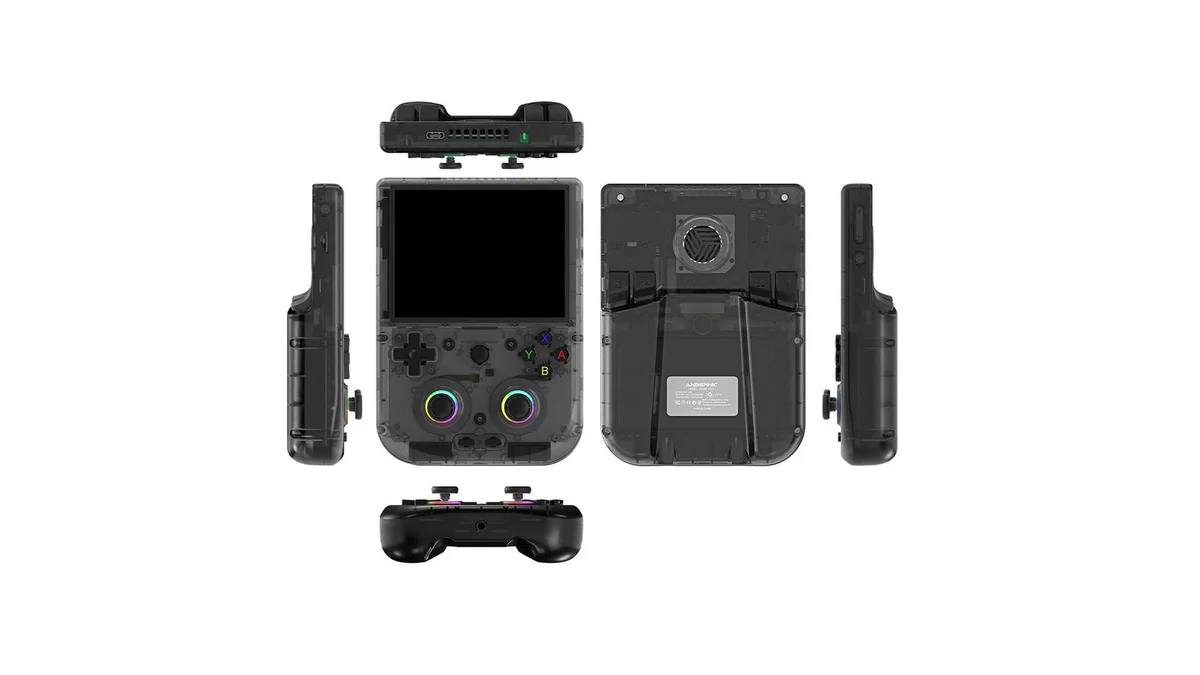
Let's address the elephant in the room: the RG477V is large for a vertical handheld. At 339 grams and with a 4.7-inch display, it's noticeably bigger than the Miyoo Mini Plus or even Anbernic's own RG406V. But that size serves a purpose. The 4.7-inch LTPS display is the largest ever fitted to a vertical Anbernic device, and the extra chassis space allows for proper active cooling.
The design language is pure Anbernic—clean lines, quality plastics, and thoughtful ergonomics. The device fills your palm in a way smaller vertical handhelds simply can't, making extended gaming sessions genuinely comfortable. Retro Game Corps' Russ called it "probably the best vertical handheld" Anbernic has ever made, and that assessment holds up.
Controls are mostly excellent. The D-pad uses Anbernic's latest iteration—larger, more responsive, and with better travel than previous models. Face buttons are snappy and well-spaced. The analog sticks, however, reveal the first compromise: they're taller than ideal with square-shaped gates and noticeable dead zones. For 3D games requiring precise camera control, you'll notice the limitation.
Display: The 120Hz Game Changer
The 4.7-inch LTPS panel is the RG477V's crown jewel. With a resolution of 1280×960 (4:3 aspect ratio), 120Hz refresh rate, and excellent color reproduction, this is arguably the best display on any vertical handheld in 2026.
Key Display Specifications:
| Feature | Specification |
|---|---|
| Size | 4.7 inches |
| Resolution | 1280×960 |
| Aspect Ratio | 4:3 |
| Refresh Rate | 120Hz |
| Technology | LTPS LCD |
| Pixel Density | ~340 PPI |
The 120Hz refresh rate is transformative. Scrolling through menus feels immediate, touch response is snappy, and the overall user experience rivals devices costing twice as much. The 4:3 aspect ratio is perfect for the systems this device targets—SNES, Genesis, PS1, GBA, N64, Dreamcast, GameCube, and PS2 all display beautifully with minimal black bars.
Brightness is sufficient for indoor play and acceptable outdoors, though not quite as legible in direct sun as AMOLED-equipped competitors. Color accuracy is good out of the box, with slightly warmer tones than the Retroid Pocket 5's AMOLED panel.
Performance: Dimensity 8300 Explained
The MediaTek Dimensity 8300 is a curious choice that defines this device's character. Built on a 4nm process, it features an octa-core CPU (1×3.35GHz Cortex-A715 + 3×3.2GHz Cortex-A715 + 4×2.2GHz Cortex-A510) paired with a Mali-G615 MC6 GPU. In CPU-bound tasks, it matches or exceeds the Snapdragon 8 Gen 1. The GPU, however, tells a different story.
Real-World Performance:
| System | Performance | Resolution |
|---|---|---|
| 8/16-bit, PS1 | Flawless | Up to 4x |
| N64, Dreamcast, Saturn | Excellent | 2-3x native |
| PSP | Excellent | 3-4x native |
| GameCube | Good | 2-2.25x native |
| PS2 | Good | 2x native |
| 3DS | Very Good | 2x native |
| Switch | Inconsistent | 0.5-1x native |
The CPU handles everything thrown at it with ease. PS2 emulation via AetherSX2/NetherSX2 runs at full speed at 2x resolution for most titles. GameCube via Dolphin performs similarly well. The issue—when it appears—is almost always GPU-related.
The Mali GPU Reality
Here's what you need to understand about the RG477V: the Mali-G615 GPU requires more attention than the Adreno GPUs found in Snapdragon-powered competitors. This isn't a dealbreaker, but it's a reality that affects daily use.
Key Considerations:
-
Vulkan vs. OpenGL: Some games require switching renderers. Russ from Retro Game Corps noted that Mario Golf: Toadstool Tour shows missing characters in Vulkan but renders correctly in OpenGL. You'll occasionally need to experiment with graphics settings for optimal results.
-
Android Game Compatibility: Don't buy this for modern Android gaming. Diablo Immortal has completely broken controls, and many touch-optimized games simply aren't designed for physical controls.
-
Switch Emulation: Skyline and Yuzu Android struggle with several titles. The Mali GPU creates compatibility headaches that Snapdragon devices avoid.
-
PC Streaming: Moonlight and Steam Link work, but the experience is subpar compared to dedicated streaming devices like the Logitech G Cloud.
The upside: For pure retro emulation through PS2/GameCube, these limitations rarely matter. The RG477V handles 95% of the retro library flawlessly.
Thermal Management: Fixed at Launch
Early units had a thermal management issue—high-performance mode saw temperatures hit 105°C during stress testing, causing significant throttling. Anbernic responded with an OTA update within days of discovery that resolved the issue.
Current units maintain reasonable temperatures (~75-80°C under sustained load) thanks to the active cooling system. The fan is audible but not obnoxious, and there's a quiet mode for less demanding games. After the thermal fix, performance is consistent and reliable.
Battery Life: Respectable Given the Power
The 5500mAh battery delivers acceptable but not exceptional endurance:
| Usage Scenario | Estimated Duration |
|---|---|
| Light gaming (8/16-bit) | 8-10 hours |
| PS1/N64 era games | 6-7 hours |
| GameCube/PS2 emulation | 4-5 hours |
| Standby drain | ~3% per 24 hours |
27W fast charging gets you from empty to full in roughly 90 minutes. The battery is appropriate for the device's performance class—don't expect Odin 2 Portal longevity, but you won't be hunting for outlets every few hours either.
Pricing and Configurations
Anbernic offers the RG477V in two configurations:
| Model | RAM | Storage | Launch Price | Regular Price |
|---|---|---|---|---|
| Base | 8GB | 128GB | $219 | $239 |
| Pro | 12GB | 256GB | $239 | $259 |
The $20 early-bird discount expires 72 hours after each batch launch. Storage is expandable via microSD, so the base model is adequate for most users. The 12GB RAM upgrade offers minimal real-world benefit for emulation but provides headroom for multitasking.
Verdict: 8/10
The Anbernic RG477V is a specialized device that excels within its intended purpose. As a vertical handheld for retro emulation through the PS2/GameCube era, it's arguably the best option available in early 2026. The Dimensity 8300's CPU performance is exceptional, the 120Hz display is genuinely luxurious, and the build quality represents Anbernic at their best.
However, the Mali GPU limitations are real. If you plan to extensively emulate Nintendo Switch, stream PC games, or play modern Android titles, look elsewhere. The Snapdragon-powered Retroid Pocket 5 or AYN Odin 2 Portal offer broader compatibility.
Buy the RG477V if:
- You specifically want a vertical form factor
- Your focus is retro emulation through PS2/GameCube
- You appreciate the 120Hz display and active cooling
- You accept occasional graphics settings tweaking
Skip it if:
- Nintendo Switch emulation is a priority
- You want hassle-free modern Android gaming
- You prefer a more pocketable device
- PC streaming is your primary use case
At $219, the RG477V delivers exceptional value for vertical handheld enthusiasts. Just understand what you're buying: a specialized retro gaming device with some GPU quirks, not a do-everything Android powerhouse.